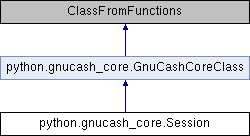
Inheritance diagram for python.gnucash_core.Session:
Public Member Functions | |
| def | __init__ (self, book_uri=None, mode=None, instance=None, book=None) |
| A convenient constructor that allows you to specify a book URI, begin the session, and load the book. More... | |
| def | __enter__ (self) |
| def | __exit__ (self, exc_type, exc_value, traceback) |
| def | raise_backend_errors (self, called_function="qof_session function") |
| def | generate_errors (self) |
| def | pop_all_errors (self) |
 Public Member Functions inherited from python.gnucash_core.GnuCashCoreClass Public Member Functions inherited from python.gnucash_core.GnuCashCoreClass | |
| def | do_lookup_create_oo_instance (self, lookup_function, cls, args) |
Static Public Member Functions | |
| def | raise_backend_errors_after_call (function, args, kwargs) |
Detailed Description
A GnuCash book editing session

To commit changes to the session you may need to call save,
(this is always the case with the file backend).

When you're down with a session you may need to call end()

Every Session has a Book in the book attribute, which you'll definitely
be interested in, as every GnuCash entity (Transaction, Split, Vendor,
Invoice..) is associated with a particular book where it is stored.
Definition at line 297 of file gnucash_core.py.
Constructor & Destructor Documentation
◆ __init__()
| def python.gnucash_core.Session.__init__ | ( | self, | |
book_uri = None, |
|||
mode = None, |
|||
instance = None, |
|||
book = None |
|||
| ) |
A convenient constructor that allows you to specify a book URI, begin the session, and load the book.
This can give you the power of calling qof_session_new, qof_session_begin, and qof_session_load all in one!
qof_session_load is only called if url scheme is "xml" and mode is SESSION_NEW_STORE or SESSION_NEW_OVERWRITE
- Parameters
-
book_uri must be a string in the form of a URI/URL. The access method specified depends on the loaded backends. Paths may be relative or absolute. If the path is relative, that is if the argument is "file://somefile.xml", then the current working directory is assumed. Customized backends can choose to search other application-specific directories or URI schemes as well. It be None to skip the calls to qof_session_begin and qof_session_load. instance argument can be passed if new Session is used as a wrapper for an existing session instance mode The SessionOpenMode.
- Note
- SessionOpenMode replaces deprecated ignore_lock, is_new and force_new.
- SessionOpenMode
SESSION_NORMAL_OPEN: Find an existing file or database at the provided uri and open it if it is unlocked. If it is locked post a QOF_BACKEND_LOCKED error.
SESSION_NEW_STORE: Check for an existing file or database at the provided uri and if none is found, create it. If the file or database exists post a QOF_BACKED_STORE_EXISTS and return.
SESSION_NEW_OVERWRITE: Create a new file or database at the provided uri, deleting any existing file or database.
SESSION_READ_ONLY: Find an existing file or database and open it without disturbing the lock if it exists or setting one if not. This will also set a flag on the book that will prevent many elements from being edited and will prevent the backend from saving any edits.
SESSION_BREAK_LOCK: Find an existing file or database, lock it, and open it. If there is already a lock replace it with a new one for this session.
- Errors
- qof_session_begin() signals failure by queuing errors. After it completes use qof_session_get_error() and test that the value is
ERROR_BACKEND_NONEto determine that the session began successfully.
- Exceptions
-
as begin() and load() are wrapped with raise_backend_errors_after_call() this function can raise a GnuCashBackendException. If it does, you don't need to cleanup and call end() and destroy(), that is handled for you, and the exception is raised.
Definition at line 311 of file gnucash_core.py.
Member Function Documentation
◆ generate_errors()
| def python.gnucash_core.Session.generate_errors | ( | self | ) |
A generator that yields any outstanding QofBackend errors
Definition at line 409 of file gnucash_core.py.
◆ pop_all_errors()
| def python.gnucash_core.Session.pop_all_errors | ( | self | ) |
Returns any accumulated qof backend errors as a tuple
Definition at line 416 of file gnucash_core.py.
◆ raise_backend_errors()
| def python.gnucash_core.Session.raise_backend_errors | ( | self, | |
called_function = "qof_session function" |
|||
| ) |
Raises a GnuCashBackendException if there are outstanding
QOF_BACKEND errors.

set called_function to name the function that was last called
Definition at line 396 of file gnucash_core.py.
◆ raise_backend_errors_after_call()
|
static |
A function decorator that results in a call to
raise_backend_errors after execution.
Definition at line 423 of file gnucash_core.py.
The documentation for this class was generated from the following file: